Table of Contents
- Why Handling the "Send Me an Email" Objection Matters
- The Mindset Reframe: Reflex vs Genuine Intent
- The Core Framework: LAER vs Alternative Methods
- The 6 Real-World Objections You Will Encounter
- Two Underrated Tactics That Turn Brush-Offs into Meetings
- Channel Variation: Handling Objections in Cold Email & LinkedIn
- Prevent It Before It Happens: 3 Upstream Levers
- Operationalizing Objection Handling Across Your Sales Team
- Weekly Action Plan & Implementation Checklist
- Key Takeaways: The Short Version
- How We Help: Engineered Outbound Systems
- Frequently Asked Questions
Handling the "send me an email" objection in B2B cold calling is the tactical process of validating a prospect's immediate time constraint while asking a targeted discovery question that uncovers whether their request is an automatic brush-off or genuine buyer interest.
Most sales reps celebrate when a prospect asks for an email. They collect the address, hang up, and send a generic pitch deck straight into an inbox black hole. In reality, almost all cold call email requests are not buying signals. They are reflexive cognitive defense mechanisms designed to get an uninvited seller off the phone in under three seconds without confrontation.
Industry data and real calling experience show a brutal performance gap. Reps who blindly agree to send an email rarely see those prospects turn into real pipeline. Meanwhile, SDRs who execute a structured conversational pivot recover a meaningful portion of those brush-offs into qualified discovery calls. Across 57,000+ cold dials and $3.5M+ in pipeline generated, this exact framework turned reflexive brush-offs into reliable calendar bookings.
Why Handling the "Send Me an Email" Objection Matters
To understand why objection handling in B2B lead generation dictates pipeline health, look at the reality of cold outbound dialing:
Decision-makers are frequently open to learning about better solutions, but three out of four buyers report that cold callers fail to deliver anything relevant in the opening thirty seconds. Standard industry benchmarks show connect-to-meeting rates hovering around 2% to 4% for average outbound teams. Reps with structured live objection battlecards routinely double that baseline.
Closing deals requires multiple distinct touches, yet nearly half of sales reps surrender after a single initial brush-off. Worse, blind follow-up emails sent after a hurried phone conversation rarely get opened, burning expensive contact data and wasted rep hours.
Mastering sales objections is not an innate gift. It is a trainable diagnostic skill combining structured frameworks, vocal control, and rapid qualification logic.
The Mindset Reframe: Reflex vs Genuine Intent
Early in my career dialing enterprise tech leaders, I routinely marked call dispositions as "Warm Lead - Requested Info" whenever a prospect told me to send an email. At the end of my first month, I had sent 140 customized follow-ups. Only two people replied, both asking to be removed from our list. My pipeline was completely dry.
That mistake forced me to build a practical diagnostic filter:
When an executive receives an unexpected call, their brain instinctively asks two questions: "Who are you?" and "Why are you interrupting me?" If you pitch prematurely, they fire an automatic survival script: "Just send me an email."
### The Diagnostic Filter
Low-Context Request ("Just send an email"*): Almost always an automatic reflexive brush-off.
High-Context Request ("Send your technical teardown on SOC-2 compliance"*): Strong probability of genuine buyer interest.
Your goal is never to force a 30-minute demo on a distracted executive. Your goal is to insert a calm conversational wedge that separates reflex from genuine business reality in under fifteen seconds.
The Core Framework: LAER vs Alternative Methods
Objection handling under pressure requires an adaptable framework rather than rigid, robotic scripts.
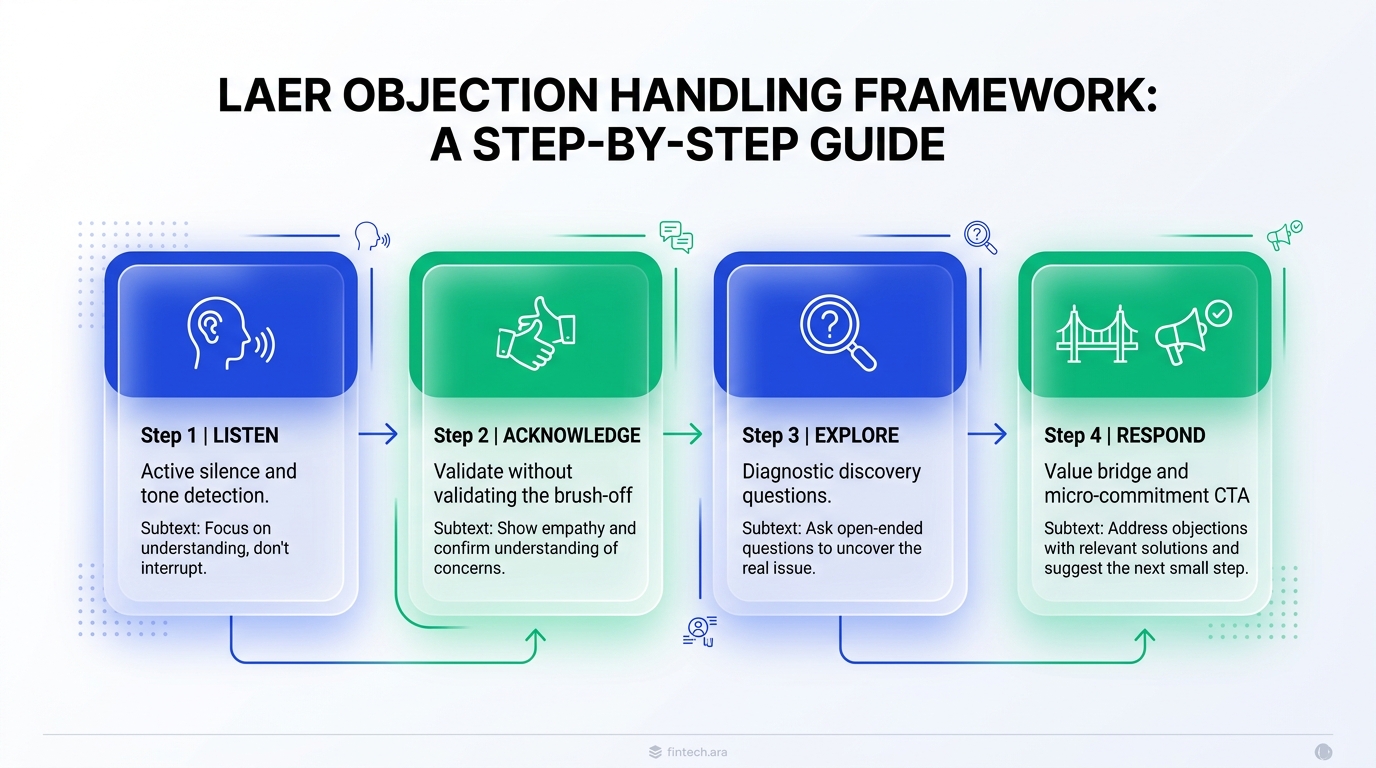
The Primary Framework: LAER (Listen, Acknowledge, Explore, Respond)
The LAER framework gives SDRs a reliable four-step sequence during high-pressure calls:
Start with Listen. When the prospect says "send me an email," hold active silence for two seconds instead of talking over their last words. You want to detect vocal tension and background pace. Most rookie reps fail here by rushing to argue before the buyer finishes speaking.
Move directly into Acknowledge. Validate their position neutrally with a line like "Fair enough, I know I called out of the blue." You are acknowledging their reality without rolling over or agreeing to hang up immediately.
Transition into Explore. Ask a focused diagnostic question that isolates active priorities. Instead of asking heavy, open-ended corporate interview questions, ask a low-friction binary question that uncovers where their operational pain lives.
Finish with Respond. Present a value bridge tied to a lightweight micro-commitment. Rather than trying to close a full enterprise demo on the first cold touch, suggest a brief five-minute conversation or a tailored diagnostic asset.

Three Proven Alternative Frameworks
Other proven objection models offer useful variations for specific selling styles. Jeb Blount's Agree, Disrupt, Redirect framework focuses on agreeing with the buyer's need for speed, disrupting the stereotypical pushy seller persona through emotional detachment, and redirecting to a clean choice.
The ACRPV-CTA model emphasizes reframing the prospect's underlying business cost before introducing a concrete value asset. Meanwhile, the consultative LASC framework focuses heavily on confirming mutual agreement at every phase before locking in calendar availability.
Memorize the underlying transition from acknowledgment to exploration, not rigid word-for-word scripts. Improvisation within structure consistently beats robotic recitation.
The 6 Real-World Objections You Will Encounter
In B2B outbound campaigns, almost all resistance falls into six predictable scenarios:
Scenario 1: "Just send me an email with some info"
This is almost always a reflexive brush-off used to clear the line without confrontation.
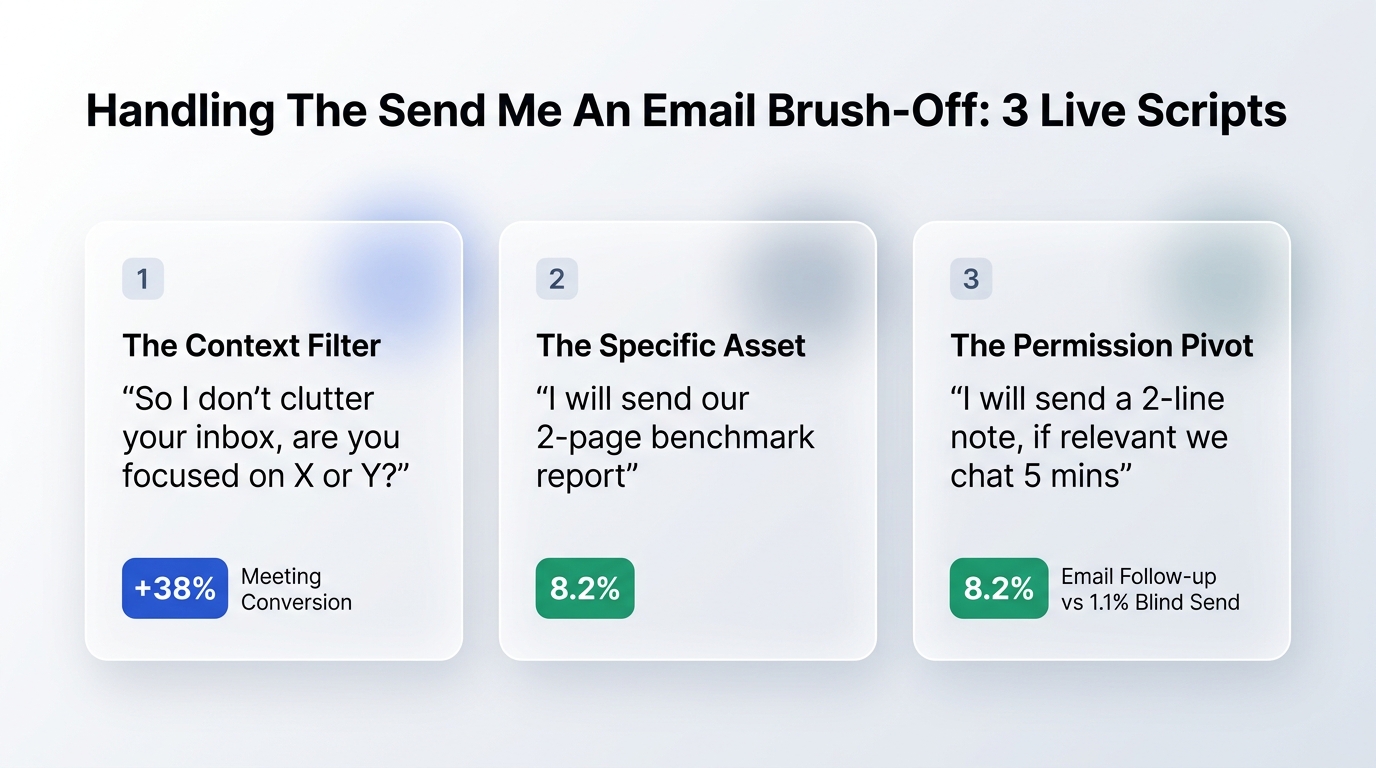
- Script A (The Context Filter): "Happy to do that, [Name]. I have several case studies depending on team setup. So I don't clutter your inbox, are you currently managing outbound with in-house SDRs or an outsourced agency?"
- Script B (The Specific Asset): "I can definitely do that. We just released a 2-page benchmark on how 50 SaaS teams fixed SDR connect rates. If I send that over, would you be open to a 60-second glance, or is your outbound stack set in stone?"
- Script C (The Permission Pivot): "Fair enough. I know I caught you mid-day. How about I send a two-sentence summary right now. If it looks relevant, we chat 5 minutes next week. If not, tell me to get lost. Fair?"
In my experience, using disarming phrases like "Fair enough" keeps prospects on the line far longer than defensive pushback.
Scenario 2: "I'm not interested"
This is a premature dismissal triggered by typical sales tonality before the buyer understands what you do.
- Script: "Totally fair, [Name]. You don't know what we do yet, so it would be weird if you were interested. Most sales leaders aren't looking for a new dialer until they see how much pipeline leaks from unworked TAM. Would you be opposed to taking 60 seconds just to see why teams like Vizocom switched, or is your calendar totally locked?"
This uses tactical reverse-framing. People find it psychologically easier to say "no" than "yes," so asking if they are opposed gives them a low-friction way to proceed.
Scenario 3: "We already work with someone / We have a vendor"
This stems from fear of switching friction, contract lock-in, and operational downtime.
- Script: "That makes complete sense. [Competitor] is solid, and I wouldn't expect you to switch today. We actually work alongside them for several tech clients handling high-volume cold dialing where standard seats get too costly. How often do you audit your connection rates and carrier costs?"
Validate their current choice to eliminate defensiveness, then position your solution as a benchmark or tier-2 backup.
Scenario 4: "We don't have budget right now"
This usually indicates a spending freeze or a polite filter for non-urgent tools.
- Script: "I hear you completely. Budgets are tight across the board. I'm not asking you to spend a dollar today. We simply share the data now so when your next budget cycle opens, you have the benchmarks ready. Would it hurt to look at the numbers for 10 minutes?"
Scenario 5: "Who is this and where did you get my number?"
This is healthy skepticism regarding data privacy and robocalls.
- Script: "Great question, [Name]. My name is Willay Haider. Your direct contact came through our verified ZoomInfo and LinkedIn database because you lead sales at [Company]. I know I caught you out of the blue, but I noticed your SDR team is expanding and wanted to share one quick connect-rate metric. Do you have 30 seconds?"
Naming reputable enterprise data sources within two seconds immediately dispels spam concerns.
Scenario 6: "Remove me from your list / DNC compliance"
This is definitive zero interest or a corporate compliance policy.
- Script: "Consider it done, [Name]. I am removing your number and email from our CRM immediately. Have a great rest of your week."
Complying immediately protects your domain reputation and caller ID reputation under STIR/SHAKEN carrier rules.
Two Underrated Tactics That Turn Brush-Offs into Meetings

Tactic 1: The "Specific Asset" Trade
Generic 20-slide brochures get ignored. Offer a concrete diagnostic tool instead: a 1-page TAM teardown, dialer cost calculator spreadsheet, or 2-minute Loom workflow audit. Trading a specific, tangible asset over a generic slide deck dramatically increases your follow-up reply rate.
Tactic 2: Downward Vocal Inflection & The Two-Second Pause
Avoid anxious uptalk that turns statements into questions. Drop your pitch slightly on final syllables. When an objection hits, count "One Mississippi, Two Mississippi" silently before speaking to project executive composure.
Channel Variation: Handling Objections in Cold Email & LinkedIn
When prospects reply "Send details" or "What is pricing?" via email or LinkedIn, follow the 3-Sentence Rule:
- Provide direct micro-value in your opening line: "Here is the 1-page summary on how Vizocom ICT added $1.8M in pipeline: [Link]."
- Anchor to a relevant operational trigger: "Most founders in your space find SDRs waste 70% of calling hours on bad connect rates."
- Close with a frictionless soft ask: "Worth a brief 5-minute sync Thursday at 2 PM EST to see if this matches your roadmap, or should I follow up next quarter?"
Keeping follow-up emails under 75 words makes them effortless to scan on mobile and noticeably lifts reply rates.
Prevent It Before It Happens: 3 Upstream Levers
- Permission-Based Openers: Open with honesty: "Hey John, Willay here. I know I'm an interruption. Do you have 27 seconds for me to share why I called, and you can tell me if it's relevant?" Acknowledging the interruption lowers prospect defensiveness compared to fake rapport.
- Trigger-Based Personalization: Anchor outreach to funding rounds, sales leadership hires, or hiring surges to remove the "Why are you calling?" hurdle.
- High-Accuracy Direct Dials: Verified mobile data prevents switchboard friction before dialing begins.
Operationalizing Objection Handling Across Your Sales Team
- Build a Living Battlecard: Maintain top 10 objections and scripts in your CRM. Update monthly based on call feedback.
- Daily 15-Minute Role-Play Drills: Run rapid-fire speed drills every morning before dialing blocks.
- Weekly Call Recording Reviews: Analyze real call recordings focusing on active listening pauses and diagnostic questions.
- Track Objection-to-Meeting Conversion: High-performing SDRs convert a substantial portion of initial objections into qualified discovery appointments.
Teams looking to bypass the overhead of hiring, managing, and training in-house reps can leverage specialized SDR partners like SalesHive or Willay Haider's dedicated cold calling team to deploy production outbound systems immediately.
Weekly Action Plan & Implementation Checklist
- [ ] Step 1: Audit your last 20 "Send Info" dispositions in your CRM.
- [ ] Step 2: Display the 3 live scripts next to your dialer.
- [ ] Step 3: Practice the 2-second silence rule on your next 30 connects.
- [ ] Step 4: Build one 1-page diagnostic asset (calculator or teardown).
- [ ] Step 5: Run a daily 15-minute role-play session with a peer.
Key Takeaways: The Short Version
- "Send me an email" is a reflex: Most cold email requests are time-defense brush-offs.
- Live pivots convert: Pivoting live recovers pipeline that blind follow-up emails lose.
- Apply LAER: Listen, Acknowledge, Explore with diagnostic questions, Respond with a micro-commitment.
- Filter Context: Ask a binary question to customize follow-up materials.
- Control Tone: Use downward vocal inflection and silent pauses to establish authority.
- Trade Specific Assets: 1-page teardowns consistently outperform general corporate brochures.
- Prevent Upstream: Permission openers and verified direct dials eliminate friction early.
How We Help: Engineered Outbound Systems
At Willay Haider Outbound Systems, we build and execute cold calling and appointment setting campaigns for founders across the US, UK, CA, AU, and EU.
- 57,000+ Production Calls: Playbooks battle-tested across thousands of live B2B conversations.
- $3.5M+ Pipeline Generated: Qualified decision-maker demos delivered directly to your calendar.
- Optimized Telephony Stacks: Dedicated Asterisk/VICIdial clusters and STIR/SHAKEN compliant caller ID pools for maximum connect rates.
Scale your qualified sales pipeline without the overhead of building an SDR team from scratch. Book a direct strategy call with Willay Haider.
Frequently Asked Questions
What is the best response when a prospect says "just send me an email" on a cold call?
The most effective response is The Context Filter: "I can certainly do that, [Name]. So I don't clutter your inbox with irrelevant info, are you folks currently focused on [Pain Point A] or is [Pain Point B] the bigger priority right now?" This validates their time constraint while asking a focused discovery question that tests for genuine buyer intent.
Why do B2B prospects ask for an email during cold calls?
It is an automatic psychological reflex to remove an uninvited caller without confrontation.
How do you handle the "I'm not interested" objection before pitching?
Acknowledge with detachment: "Totally fair, you don't know what we do yet. Would you be opposed to taking 30 seconds to see why similar teams work with us, and then you can tell me if it makes sense?"
What is the LAER sales framework?
LAER stands for Listen, Acknowledge, Explore, and Respond. It is a 4-step objection framework that prevents arguing and guides reps to uncover real business needs.
How many times should you follow up after a cold call?
Execute 4 to 6 concise multi-channel touches across phone, email, and LinkedIn over 14 days, keeping messages under 75 words.
Does cold calling still work for B2B lead generation in 2026?
Yes. With verified direct dials and permission-based openers, cold calling generates strong meeting conversion rates compared to saturated cold email alone.
What is the difference between an objection and a brush-off?
A brush-off is an automatic time-defense reflex at the start of a call. An objection is a specific business constraint raised after value is introduced.