Section 1: Why Hiring Managers Roleplay Instead of Just Asking Questions
When I interview BDR and SDR candidates for enterprise outbound teams, I never evaluate candidates based on memorized resume bullet points. As sales author Jeb Blount notes in Fanatical Prospecting: "The easiest way to lose peer status in sales is sounding like you have something to prove." Live roleplay tests the single capability that determines whether an outbound caller hits quota: live conversational composure under pressure. Hiring managers score three specific signals during mock dials: steady pacing without nervous speedups, natural recovery from immediate brush-offs, and structured active listening rather than rushing to pitch.
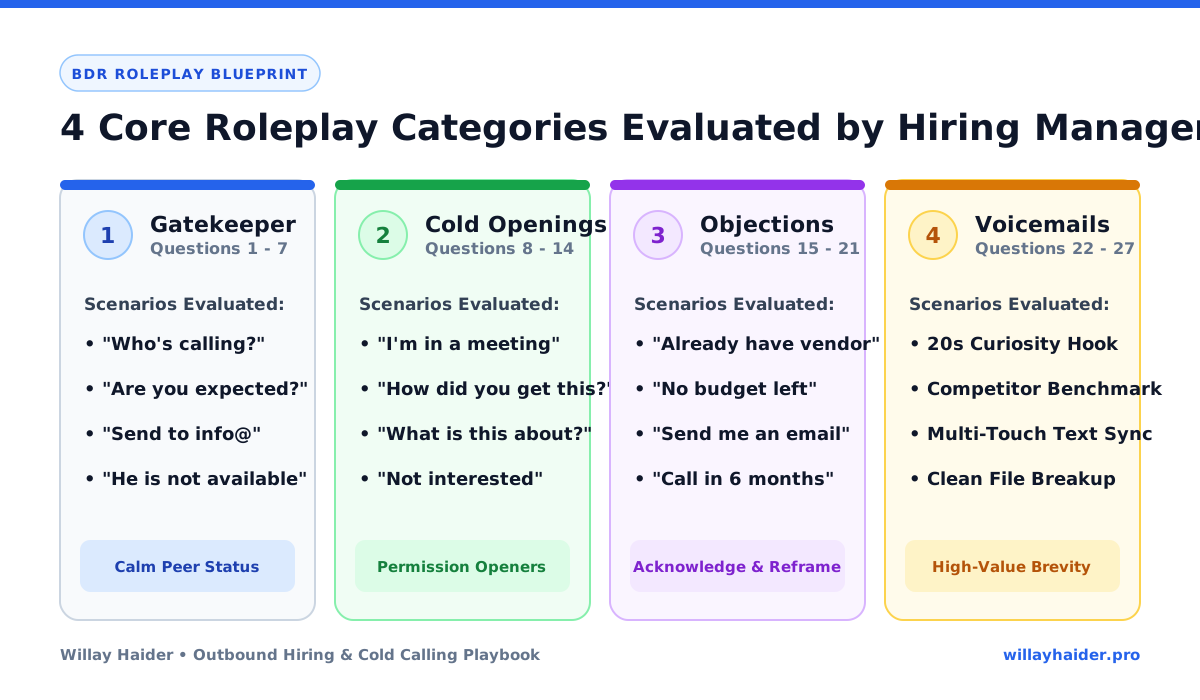
Before walking through the mock dialogue, look at how hiring teams structure the core interview evaluation stages:
Section 2: The 27 Roleplay Questions and Mock Spoken Answers
Gatekeeper Roleplay Scenarios (1 to 7)
1. Scenario: The gatekeeper asks, "Who is calling and what company are you with?"
Mock Answer: "Hey, it is Willay with Million Dials. Is Greg available for a quick moment?"
2. Scenario: The gatekeeper asks, "Is he expecting your call?"
Mock Answer: "He is not expecting my call directly, no. We are tracking their freight route expansions in Ohio and I wanted to see if this sits on his desk or someone else's."
3. Scenario: The gatekeeper says, "We do not take cold sales calls. Send an email to info@."
Mock Answer: "Understood. Info@ usually goes into a general marketing inbox. Would you mind letting me know who heads up carrier procurement so I address it to the right person?"
4. Scenario: The gatekeeper says, "He is in back-to-back meetings all afternoon."
Mock Answer: "No problem at all. When does he usually catch his breath between meetings, early morning or toward the end of the day?"
5. Scenario: The gatekeeper asks, "What is the exact reason for the call?"
Mock Answer: "It is regarding their supply chain dispatch workflows. I just had a quick 30-second operational question for his team."
6. Scenario: The gatekeeper puts you on hold for 2 minutes and returns saying, "He is busy."
Mock Answer: "Thanks for checking. I will try him back tomorrow morning before his schedule fills up. Have a great afternoon."
7. Scenario: The automated operator asks for an extension number.
Mock Answer: "Press 0 or dial direct-dial extensions sourced from verified databases like [Apollo.io](https://www.apollo.io) to bypass standard front-desk phone routing."
Once you demonstrate that you can navigate gatekeepers with neutral confidence, hiring managers and talent screening panels immediately evaluate how you hook the prospect when they pick up live:
Cold Call Opening Roleplays (8 to 14)
8. Scenario: The prospect answers aggressively with, "Who is this and how did you get my direct cell?"
Mock Answer: "Fair question, Greg. This is Willay with Million Dials. Your mobile was listed on your public logistics profile, and I know I caught you out of the blue. Do you have 30 seconds to tell me if I should stay on the line or hang up?"
9. Scenario: The prospect says, "I am stepping into a meeting right this second."
Mock Answer: "Got it. I will keep this to 10 seconds. We built a framework helping mid-sized carriers cut deadhead miles. Can I send a 2-sentence email, or should I try you Thursday morning?"
10. Scenario: The prospect says, "I am not the right person for this."
Mock Answer: "Appreciate you telling me upfront. Usually logistics operations or fleet management handles carrier dispatch. Who on your leadership team oversees that division?"
11. Scenario: The prospect says, "What is this regarding? I do not have time for a sales pitch."
Mock Answer: "I hear you, and this is not a product demo pitch. We track mid-market supply chains in Ohio. I just wanted to verify if carrier detention fees are currently an active bottleneck on your board."
12. Scenario: The prospect remains completely silent after you introduce yourself.
Mock Answer: "I know I called you without warning. The reason I reached out is because we noticed your recent headcount growth in regional freight dispatch."
13. Scenario: The prospect asks, "Is this a cold call?"
Mock Answer: "It is 100% a cold call, Greg. You want to hang up right now, or give me 20 seconds to explain why I dialed your number specifically?"
14. Scenario: The prospect sighs and says, "Make it fast."
Mock Answer: "Understood. Most VPs of Supply Chain we partner with tell us their dispatchers waste 3 hours daily on manual rate renegotiations. Is that something your team is experiencing right now?"
During live interview roleplays, interviewers simulate real-world prospect pushback to test whether you get defensive or know how to acknowledge and reframe objections naturally:
Live Objection Handling Roleplays (15 to 21)
15. Scenario: The prospect says, "We already have a vendor handling this."
Mock Answer: "Most logistics leaders we talk to do. We are not looking to replace your current partner. We work alongside existing providers specifically to handle peak-season overflow. How long have you been with them?"
16. Scenario: The prospect says, "We do not have any budget for new software this quarter."
Mock Answer: "Totally respect that. Most teams have frozen unallocated spend until Q4. We are not asking for a contract today. If we could show you how to reduce detention costs before your next budget cycle, would you be open to a 10-minute glance?"
17. Scenario: The prospect says, "Just send me an email with information."
Mock Answer: "I would be happy to send an overview. To make sure I do not send you generic fluff, what is the single biggest bottleneck your dispatch team is focused on solving this quarter?"
18. Scenario: The prospect says, "Call me back in six months."
Mock Answer: "Happy to put a reminder on my calendar for March. Just so I have context when I follow up, what changes in your operational roadmap between now and then?"
19. Scenario: The prospect says, "I have never heard of your company."
Mock Answer: "That makes complete sense, we are an emerging outbound systems partner. We specifically focus on mid-sized logistics and healthcare procurement teams. Would you be open to hearing how we booked 1,800+ qualified demos for peer operators?"
20. Scenario: The prospect says, "Your competitor offers this for half the price."
Mock Answer: "They definitely have competitive starter pricing. The reason enterprise teams switch to us is our data verification models and zero-bounce delivery rates. Are you experiencing data quality issues with them currently?"
21. Scenario: The prospect says, "I am happy with our internal team."
Mock Answer: "That is great to hear. Internal SDRs are crucial for inbound routing. Where we usually plug in is high-volume outbound account list prospecting that internal reps do not have time to build."
Voicemail & Multi-Touch Follow-Up Roleplays (22 to 27)
22. Scenario: Leave a 20-second executive curiosity voicemail.
Mock Answer: "Hey Greg, Willay here with Million Dials. Noticed your recent fleet expansion in Ohio and had a question regarding carrier detention workflows. I sent a 2-line email to your inbox. My direct number is 555-0192. Talk soon."
23. Scenario: Leave a competitor benchmark voicemail.
Mock Answer: "Hi Sarah, Willay calling. We just helped a peer regional carrier reduce dispatch renegotiation time by 35%. Wanted to share the benchmark data with your operations team. Check your inbox for my note, or call me at 555-0192."
24. Scenario: Follow up on an email that received no reply.
Mock Answer: "Hey Greg, Willay following up on the dispatch benchmark note I sent Tuesday. Wanted to check if carrier detention is a priority for Q3, or if your team is already fully optimized here."
25. Scenario: Re-engage a prospect after a postponed demo.
Mock Answer: "Hey Michael, Willay here. We had tentatively scheduled 10 minutes last month to review supply chain routing. Wanted to see if your calendar opened up this week for a quick check-in."
26. Scenario: Multi-channel text message follow-up after a voicemail.
Mock Answer: "Hey Greg, Willay with Million Dials. Just left you a brief voicemail regarding dispatch automation in Ohio. No need to call back, dropped a 2-line summary in your email."
27. Scenario: The polite breakup voicemail / email.
Mock Answer: "Hey Greg, Willay here. I have reached out a few times regarding freight optimization. It seems this might not be a focus right now, so I will close your file and stop following up. If anything changes down the road, feel free to reach out."
Core BDR Interview Questions by Experience Level
General & Entry-Level BDR Interview Questions
- "Tell me about yourself and why you want to work in tech sales."
Focus on coachability, grit, and curiosity. Share how you manage high-volume activity and why outbound pipeline generation excites you.
- "How do you handle rejection and maintain high daily activity?"
Explain that cold call rejection is not personal, it is a filtering mechanism. Top SDRs treat dials as data points to identify the 5% of prospects actively looking for a solution.
- "Do you like cold calling?"
Answer honestly: "I enjoy the challenge of turning an unscripted conversation with a stranger into a meaningful business relationship." Review our breakdown on How B2B Cold Calling Actually Works in 2026.
- "How do you manage your time and stay organized during 80+ dial sprints?"
Discuss calendar blocking, power-dialing sessions, and automated CRM task queues in HubSpot or Salesforce.
Senior-Level BDR & Team Lead Interview Questions
- "How do you qualify outbound leads using BANT or CHAMP frameworks?"
Break down how you uncover Challenges, Authority, Money, and Prioritization through open-ended discovery questions without interrogating the buyer. For complete cadence models, see our Top 7 Appointment Setting Frameworks Guide.
- "What differentiates good BDRs from the best BDRs?"
Good BDRs hit activity metrics; the best BDRs conduct account research, build clean prospect lists with tools like LinkedIn Sales Navigator, and maintain high CRM data hygiene. Read our guide on How to Export Unlimited Leads from LinkedIn Sales Navigator Without Paid Extensions [2026].
- "How do you handle negative feedback during a 1-on-1 call review?"
Show that you embrace call recording teardowns, ask for specific tonal adjustments, and apply feedback immediately on your next dialing block.
Proven Operational Outcomes: 1,800+ Demos Booked
When I built and scaled the outbound outbound development infrastructure for Million Dials Pvt Ltd., we trained our SDR team on these exact roleplay frameworks paired with data-driven list enrichment and automated HubSpot Workflows.
Over multiple enterprise campaigns across US logistics, healthcare technology, and SaaS verticals, our team achieved:
- 1,800+ verified B2B discovery demos booked with VP and C-level decision-makers.
- $2.5M+ in verified closed revenue pipeline generated from cold outbound cadences.
- 72% average demo attendance rate, driven by clear confirmation workflows and unscripted conversational discovery.
As an operational builder holding the Google Data Analytics Professional Certificate and IBM Data Science Credentials, I build outbound SDR frameworks rooted in verifiable metrics, conversational psychology, and rigorous CRM discipline.
Section 3: How to Practice These Before Your Interview
To master these roleplays before your interview:
- Record Voice Memos: Record yourself speaking each mock answer into your phone. Listen back to your tone: did you sound hesitant, or did you speak with calm peer status?
- Time Your Pacing: Ensure your cold call openings stay strictly under 18 seconds. Rushing signals desperation, while calm pacing commands respect.
- Practice With a Timer: Set a 3-second timer before responding to simulate live conversational pauses instead of blurting out rehearsed answers.
Frequently Asked Questions
What is the difference between an SDR and a BDR?
In most modern B2B tech organizations, SDRs (Sales Development Representatives) focus primarily on qualifying inbound leads (website demo requests, content downloads), while BDRs (Business Development Representatives) focus on outbound prospecting (cold calling, cold email, and social selling into target account lists).
How much does a Business Development Representative earn in 2026?
In the US market, entry-level BDR base salaries range from $50,000 to $65,000, with an On-Target Earnings (OTE) potential of $75,000 to $95,000+ when including monthly commission bonuses. Senior enterprise BDRs and team leads earn OTEs ranging from $100,000 to $125,000.
Is being a BDR a stressful job?
BDR roles can be challenging due to high daily activity expectations and rejection volume. However, top performers who rely on structured data pipelines, automated CRM cadences, and unscripted discovery frameworks build repeatable workflows that reduce stress and ensure consistent quota attainment.
How do you deal with cold call rejection in an interview roleplay?
Hiring managers intentionally throw harsh objections during roleplays to test your emotional resilience. Never argue with the interviewer. Acknowledge their perspective neutrally ("That makes total sense"), reframe the problem, and ask an open-ended discovery question.
What qualification frameworks should every BDR candidate know?
Candidates should understand BANT (Budget, Authority, Need, Timeline) and CHAMP (Challenges, Authority, Money, Prioritization). Demonstrating that you prioritize understanding a prospect's operational bottlenecks before pitching is what sets top candidates apart.
Next Steps
If you are scaling an outbound team or want to refine your appointment setting pipeline, feel free to explore our approach or get in touch.