
The 3 Seconds Right After They Push Back
You dial a direct number on Apollo.io, wait out two rings, and a guy answers in the middle of a noisy warehouse or between meetings. You get maybe eight words out of your mouth, and he immediately cuts you off:
"Look, I'm not interested."
Your pulse jumps. You've got about three seconds to decide what you're doing next.
Most junior reps panic here. They either apologize and hang up ("Oh sorry to bother you, have a good one!") or they jump right into defense mode ("Wait, let me just explain our features for 30 seconds!"). Both kill the call on the spot.
I've logged more than 57,000 cold calls over the last few years. I've dialed managing partners at law firms for OMC Group LLC, hospital procurement directors for Vizocom ICT LLC, and SaaS founders for Million Dials Pvt Ltd.
If there is one thing that changed my entire outbound career - and something I break down in my guide on How B2B Cold Calling Actually Works in 2026 - it's this:
Nobody on a cold call is actually objecting to your product. They don't even know what your product does yet. They are just reacting to the fact that an uninvited person interrupted their Tuesday morning.
Once you realize that an objection is just an automated reflex to protect their time, cold call objection handling stops feeling like a debate. You don't have to "win" anything. You just have to acknowledge the interruption, stay completely relaxed, and steer the conversation into a calm diagnosis.
5 Practical Habits I Rely On for Every Calling Block
These aren't classroom sales theories. These are the specific habits that kept my show-up rate above 70% and booked 1,800+ demos when running high-volume outbound blocks:
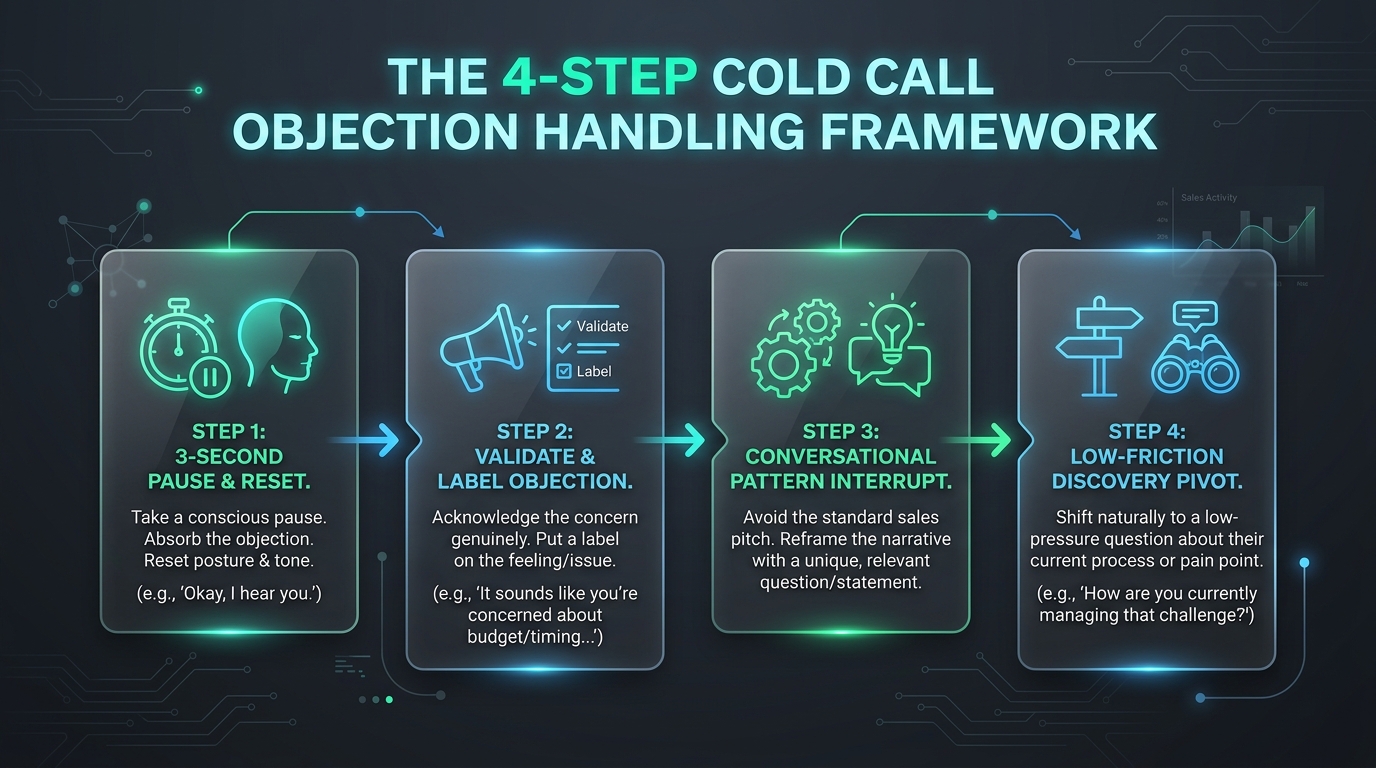
1. Take a 2-Second Pause Before You Speak
The instant a prospect pushes back, the natural human urge is to talk over them or respond at double speed. That fast reaction sounds defensive and desperate. When someone says "We don't need this," I literally take a slow breath, wait a full two seconds, and then speak at a slightly slower pace than they did. That tiny pause alone signals that you're a calm peer who isn't shaken by basic pushback.
2. Agree With Them Immediately (Never Argue)
The fastest way to lose a cold call is telling a prospect why they're wrong. If they say "We're good," fighting them makes their guard shoot up. Instead, agree with them upfront: "Yeah, totally fair," or "I hear you." Once they see you aren't trying to trap them into an argument, the defensiveness fades and you can actually have a normal conversation.
3. Give Them an Easy Way Out (The Pressure Release)
When prospects feel trapped, they hang up. The moment you give them explicit permission to say no - using phrases like "If this isn't relevant, just tell me and I'll get out of your hair" - they suddenly relax. Ironically, giving people the freedom to end the call makes them much more willing to give you another 20 seconds.
4. Zero In On One Specific Friction Point
Don't try to explain your whole company on a 90-second cold dial. When I was calling fleet operators for Autolift Transport / Nexus LTD, I didn't pitch an entire dispatch service. I just asked if their dispatchers were spending two hours a day arguing over broker detention fees. That's it. One concrete headache is easy to discuss; a generic "growth platform" isn't.
5. Ask for 20 Seconds, Not a 30-Minute Meeting
Reps fail on objections because they try to close for a demo calendar invite before the prospect even admits they have a problem. As we explore in our Top 7 Appointment Setting Frameworks, your only goal when handling a cold objection is earning the right to ask one good discovery question. Trade value for 20 seconds of their attention, not half an hour of their week.
What Common Objections Sound Like in the Real World
Here is how I actually handle the pushback I hear every week on live dials - no corporate fluff, just real spoken language:
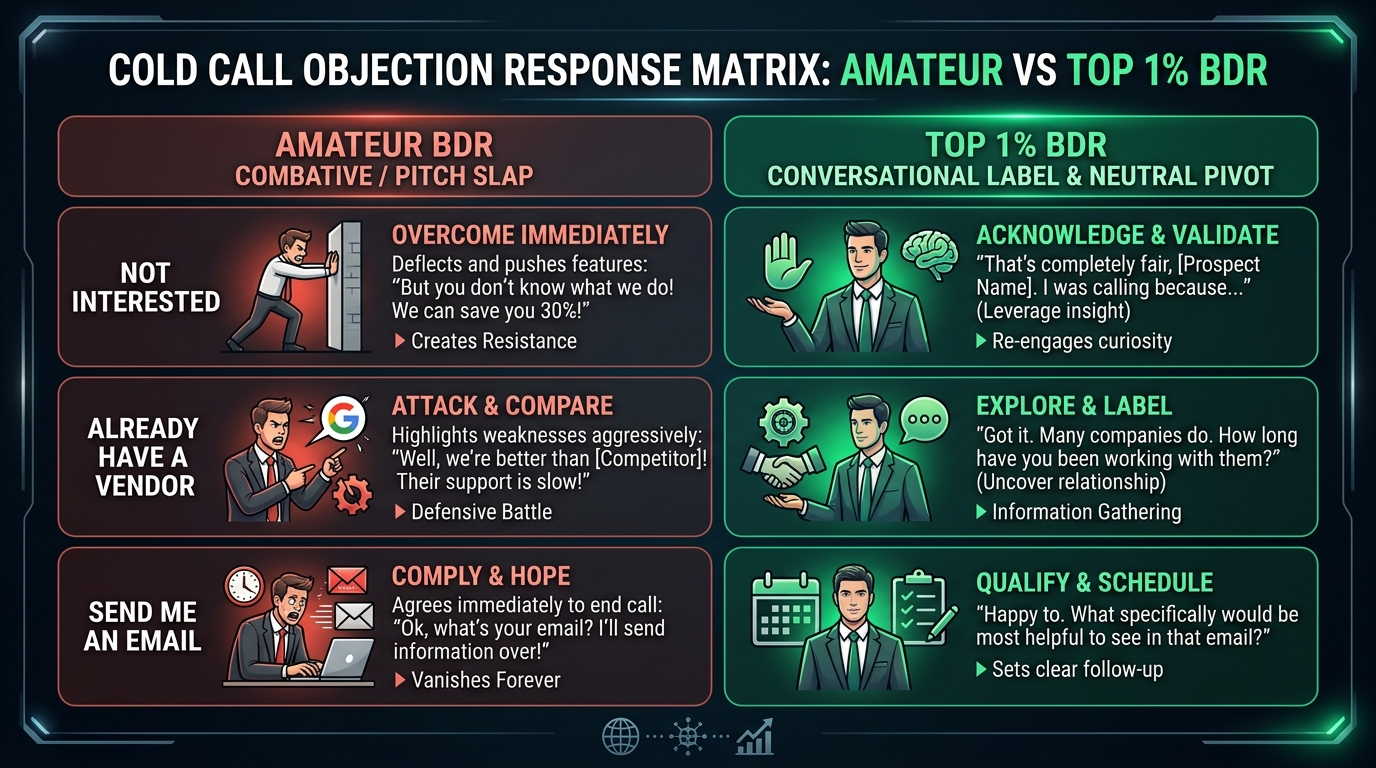
"I'm not interested"
This is the default reflex. They haven't processed who you are. The worst thing you can do is ask "Why aren't you interested?" because that forces them to invent a reason to reject you.
Instead, I just keep it light and conversational:
"Yeah, that's completely fair - you don't even know why I called yet. Give me twenty seconds to tell you why I reached out to your desk specifically, and if it's irrelevant, just tell me to get lost. Fair enough?"
Most people chuckle or say "Alright, twenty seconds, go." That's all the opening you need.
"We already have a vendor / We already have a solution for this"
When I was booking discovery calls for B2B SaaS teams at Million Dials Pvt Ltd., almost every VP of Sales we dialed already had tools like Salesloft or external SDR agencies. If you attack their current vendor, you're basically telling them they made a bad decision.
Acknowledge their setup, validate it, and test whether there's room for a backup:
"Got it. Honestly, if you didn't have someone in place by now, I'd be surprised. We're definitely not asking you to switch providers or rip anything out today. Out of curiosity, are they handling your entire outbound queue, or do you guys ever need a secondary benchmark for overflow campaigns?"
This reframes your offer as low-risk insurance rather than a painful migration project.
"Just send me an email"
This is the polite dismissal. If you just say "Sure, what's your email?" and hang up, you've wasted your dial. That email will rot in their spam folder unless you've already built targeted relevance - a topic we cover in our B2B Cold Email Warmup & Deliverability Guide.
Agree to the email, but use it as a bridge to qualify what they actually care about:
"Happy to shoot an email over. I've got your address here as [confirm their email]. Just so I don't send you a generic five-page slide deck that wastes your afternoon - what's the main bottleneck your team is trying to fix in your pipeline this quarter?"
If they give you a real operational answer, you now have a genuine angle for follow-up. If they can't name one, you know it was just a brush-off.
"Now isn't a good time / I'm walking into a meeting"
Sometimes this is an excuse, but often it's the simple truth - you caught someone while they're walking down a hall or grabbing coffee. Respect their time immediately:
"Hear you loud and clear. Can I steal fifteen seconds right now to see if this is even worth putting on your radar, or should I ping you Thursday morning around 10?"
When you give two quick options, most executives will either give you the fifteen seconds right then or commit to a specific callback window.
"We don't have any budget right now"
During Q4 prospecting blocks, budget freezes come up constantly. If you immediately offer discounts or drop your price, you look desperate and damage your credibility.
Take the financial pressure off the table completely:
"Totally understand. Most finance teams have frozen discretionary spend until next quarter anyway. We're not asking for a purchase order or a contract today. Would you be open to taking a look for 10 minutes so you have benchmark numbers ready whenever planning unlocks?"
"How did you get my direct number?"
When you're pulling mobile numbers through Apollo.io or extracting verified executive contacts using our LinkedIn Sales Navigator Masterclass workflows, some prospects will get defensive about privacy. Never lie and say a colleague gave it to you. Radical honesty disarms the suspicion:
"Fair question! I pulled it off your public profile on [Apollo.io](https://www.apollo.io), specifically because I saw you oversee regional dispatch at [Company]. I know I caught you completely unannounced - did you want me to hang up, or can I take twenty seconds to explain why I dialed you specifically?"
"I'm not the right person for this"
Don't argue with their title. As we practice during our BDR & SDR Roleplay Coaching Scenarios, treat this as an easy route to a warm internal referral:
"Appreciate you telling me upfront. Who on the team usually handles the dispatch operations so I don't keep bugging the wrong desk?"
When they give you a name, you can dial that person next and say: "Hey Mark, your colleague Sarah mentioned you oversee carrier dispatch..." That's no longer a cold dial - it's a warm internal referral.
"We tried something like this before and it didn't work"
When dialing healthcare procurement accounts for Vizocom ICT LLC, we ran into prospects who had been burned by low-quality outbound agencies that blasted generic spam and ruined domain reputations.
Validate their frustration instead of defending the industry:
"I hear that all the time, honestly. There are a ton of bad agencies out there that blast canned scripts and burn leads. When you ran that campaign, was the problem that the lead data was junk, or was the rep just not able to hold real conversations with decision-makers?"
By diagnosing why the past attempt failed, you demonstrate that you understand the mechanics of outbound far better than the vendor who let them down.
Field Notes on Tonality & Audio Setup
The exact words you say only account for half the result. The rest comes down to vocal presence and your phone setup:
- Downward Inflection: Inexperienced callers often end sentences with an upward pitch, which makes simple statements sound like nervous questions. Top reps speak with a calm, flat downward inflection - the exact same way an experienced doctor talks during a consultation.
- Emotional Detachment: If you sound anxious or desperate to book a meeting, prospects feel that pressure immediately and pull away. When you sound relaxed - like you're genuinely just checking whether there's an actual operational fit - they open up.
- Logging Everything in CRM: When running campaigns across HubSpot CRM, Salesforce, or Zoho CRM, always log the exact objection type in your call dispositions. Tracking patterns in conversation intelligence platforms like Gong.io tells you whether your market is pushing back on timing, vendor loyalty, or message clarity.
- Dialer Efficiency: High-volume teams dialing on VICIdial or cloud VoIP on RingCentral should always monitor connection latency so you don't introduce awkward audio lag right as the prospect says hello.
Need Dedicated Outbound Pipeline Without the Headaches?
Training internal SDRs to handle objections smoothly takes daily call reviews, ongoing coaching, and expensive dialing infrastructure.
If you're a founder or agency owner who wants qualified decision-maker demos placed directly on your calendar without the burden of managing cold callers yourself:
- Explore my verified case studies & client results to see past campaign outcomes.
- Check out my transparent outbound pricing for flexible and full-time packages.
- For agency owners looking for dedicated full-time talent, learn more about my in-house hiring & consulting model.
- Or reach out directly for an outbound consultation to talk through your target accounts.
Frequently Asked Questions
What is cold call objection handling?
In plain English, it is the habit of staying completely calm when a prospect pushes back. Instead of panicking or blurting out product features, you acknowledge that you interrupted them, lower the sales pressure, and ask one simple question to see if there is an actual problem worth discussing.
What is the most common cold call objection?
Hands down, it is "I'm not interested," followed closely by "Just send me an email" and "We already have a vendor." Almost none of these are genuine rejections of what you sell - they are just automatic reflexes busy people use to get uninvited callers off the phone. Treat them like a minor speedbump, not a brick wall.
What should you say when a prospect says not interested?
I usually keep it relaxed and give them an easy out: "That's completely fair - you don't even know why I called yet. Give me twenty seconds to tell you why I reached out to your desk, and if it's totally irrelevant, tell me to hang up. Fair enough?" It breaks the tension and almost always earns you twenty seconds of real attention.
How do you handle the "we already have a vendor" objection?
Never argue with them or criticize their current provider. I say: "Makes total sense, most teams we talk to already have someone in place. We definitely aren't asking you to switch today. Out of curiosity, are they covering your entire outbound queue, or do you guys ever need a secondary benchmark for overflow campaigns?" It positions your offer as a backup benchmark rather than a messy replacement project.
How can sales leaders help reps handle objections better?
Throw out the 40-page script binders. Run quick 15-minute roleplay drills before morning dial blocks, listen to actual call recordings in tools like Gong.io, and coach reps to slow their speaking pace down and use flat downward vocal inflection instead of sounding like an over-enthusiastic telemarketer.